
The real problem isn't the toy
When a partner says they don't want toys in the bedroom, what they're usually saying is something deeper. They might feel inadequate. They might worry it means you're not satisfied. They might see it as a threat to their role or their desirability. Or they might just have had a bad experience with toys before and haven't recovered from it. Understanding what's underneath the no is half the battle.
Here's what I see in my practice: couples rarely break up over a vibrator itself. They break up over the conversation around it. Someone brings it up poorly, the other person gets defensive, and suddenly you're not talking about a lemon clitoral vibrator anymore. You're talking about whether your partner loves you, whether you're attracted to them, whether they care about your pleasure.
So let's separate those threads.
Why your partner might actually be saying no
There are roughly five categories here, and knowing which one your partner sits in changes your entire approach.
The insecurity angle. Your partner thinks a toy means they're not enough. They interpret your interest in a lemon vibrator as criticism. This is the most common one, and it's usually fixable with reassurance and reframing.
The ego angle. Related to insecurity, but different. Your partner sees toys as emasculating or threatening to their identity as a lover. This one requires gentler unpacking and sometimes a bit of redefining what "good sex" even means.
The skepticism angle. Your partner just thinks toys are gimmicky, unnecessary, or silly. They're not threatened. They just don't see the point.
The trauma angle. Something about toys triggers an old wound. A previous partner introduced one in a way that felt violating. They were pressured. Something went wrong. This needs care and patience.
The boundary angle. Your partner simply doesn't want toys in their sex life, and that's a legitimate preference. Not every no has a reason to dig into. Sometimes it's just a no.
The conversation you actually need to have
Don't lead with the vibrator. Lead with curiosity.
Pick a time when you're not naked and not about to have sex. Suggest getting tea or taking a walk. Say something like: "I've been thinking about bringing up something about our sex life, and I want to do it right. Is now okay?" This signals that it matters and you're not just springing it on them mid-passion.
Then ask: "When you think about us using toys, what comes up for you?"
Listen. Don't interrupt. Don't explain or defend yet. Let them finish. If they say "I feel like you're not satisfied with me," your job is to say, "I hear that. That makes sense you'd feel that way. Can you tell me more about it?" You're gathering information, not launching a counter-argument.
Once you actually know what's going on, you can address it. If it's insecurity, you might say: "I'm asking because I want more pleasure, not because you're not enough. I want to feel really good, and I want you to see me feel really good. That's about us both winning." If it's ego, you might say: "This isn't about replacing you. It's an addition. Like how a toy piano doesn't mean you don't want a real one." If it's skepticism, you might say: "I just want to try it. If we both hate it, we stop."
The lemon vibrator becomes a detail later. The conversation is about why your partner is resisting and whether that reason is actually true.
How to introduce it without forcing it
After the conversation, if your partner is still resistant but not firmly shut down, you have options.
Option one: Do it alone first. Tell your partner you're going to use it by yourself for a while. Show them it's not shameful or weird. Demonstrate that you're not hiding it. Let them see you enjoy something that feels good. Sometimes watching someone you love experience uncomplicated pleasure normalizes it faster than any argument could.
Option two: Slow integration. Don't debut the lemon vibrator during sex. Mention it exists. Leave it on the nightstand. Make it ordinary. People fear things they've never seen. Things they see every day lose their power.
Option three: Make it about them. "I'd love if you used this on me." This can feel less threatening than "I want to use this." It positions the toy as a tool they control, which sometimes addresses the insecurity or ego piece. Your partner goes from feeling replaced to feeling like they're enhancing the experience.
Option four: Let it sit. Sometimes no actually means not right now. If you've had the conversation and your partner is genuinely not interested, you have three choices: respect the boundary, have a deeper talk about whether this is a compatibility issue, or use toys solo when you're alone. There's no universe where pressuring someone into accepting toys creates better sex or a better relationship.
What happens if they still don't want it
Here's the hard part. If your partner continues to refuse and it's something you genuinely need for your pleasure, you're at a compatibility question, not a communication question. That's different and deserves its own conversation.
You might say: "I respect that toys aren't for you. And I also know that my body works best when I have access to them. I'm wondering if we can find a middle ground." That middle ground might be: you use toys solo, you use toys when your partner isn't present, or your partner uses the lemon vibrator on you even if they don't personally enjoy it.
Or it might mean talking to a couples therapist, which is actually the right call here. This isn't a quirk or a preference. It's touching on desire, pleasure, control, and whether both people's needs matter equally. That's real stuff, and professional help is legit.
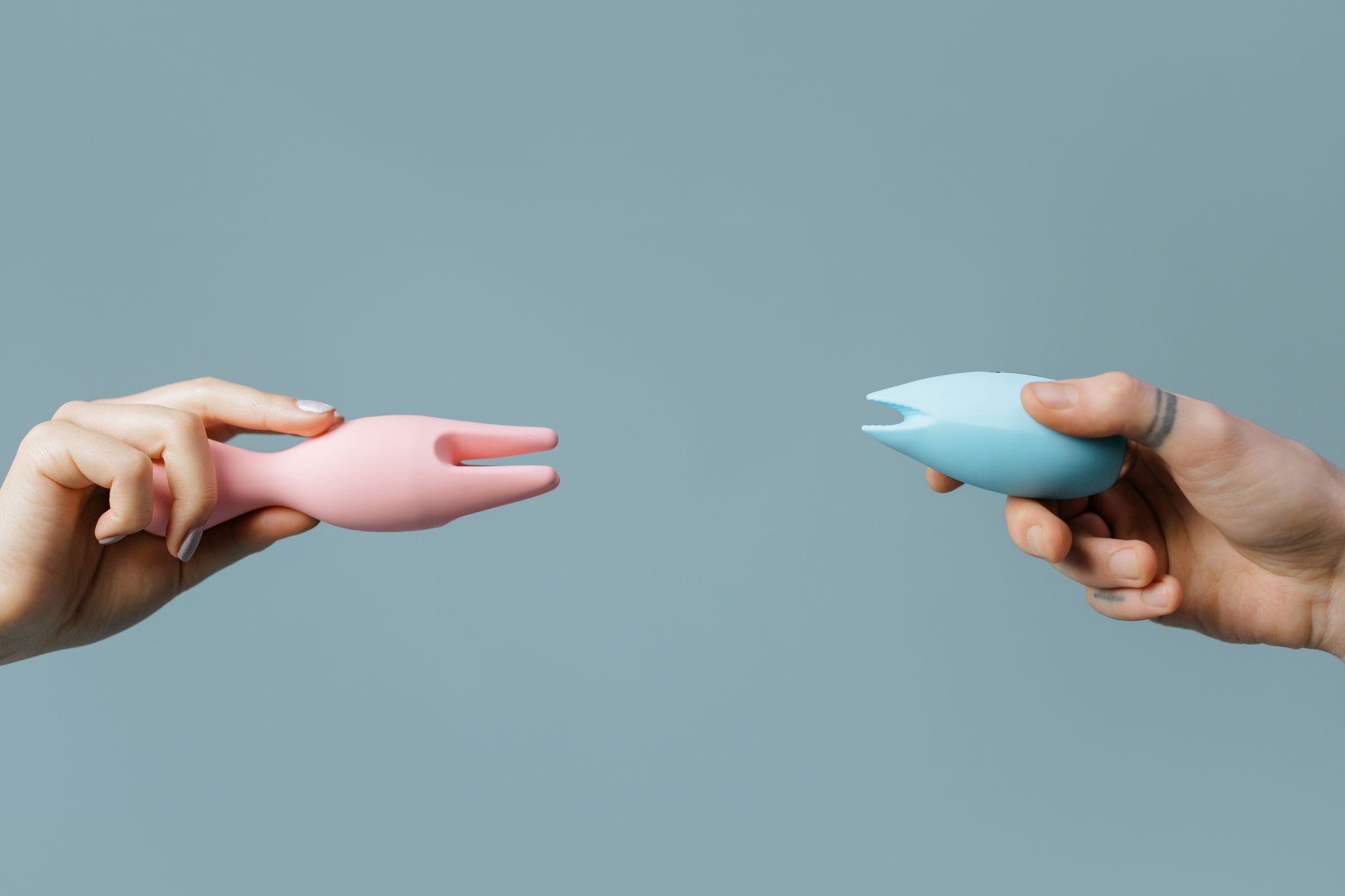
Photo by cottonbro studio on Pexels
The bridge between your needs and their comfort
Let's say your partner is coming around but still anxious. There are practical things that help.
Start with a device that doesn't feel clinical. A lemon clitoral vibrator doesn't look like medical equipment. It looks modern and elegant, which somehow makes it less threatening than something that looks explicitly designed for sex. Form matters more than you'd think.
Use it together the first time. Don't ambush your partner with it mid-sex. Introduce it deliberately. Show them how quiet it is. Let them hold it. Demystify it. Then when you use it during sex, it's not a surprise. It's a thing you both agreed to.
Keep talking about what feels good. Don't go silent and let your partner imagine worst-case scenarios. Say things like: "I love when you do this while I use this." Connect the toy to the partnership. Make it collaborative, not competitive.
If your partner asks questions, answer them fully. How do you clean it? Where did you buy it? What made you want to try it? Transparency kills anxiety in a way that defensiveness never will.
When to know it's not just about the vibrator
If your partner refuses toys because they think you're unfaithful, not attracted to them, or seeking something they can't provide, the toy is not the problem. The problem is trust or desire or something systemic in your relationship. Using a lemon vibrator won't fix that. Getting real about what's broken will.
Similarly, if your partner's resistance comes with controlling behavior ("You can't do that", "That's wrong", "I forbid it"), that's a separate red flag. Your pleasure matters. Your autonomy matters. A partner who doesn't see that is showing you something important about them.
But if your partner's hesitation comes from genuine vulnerability or a bad experience, and they're willing to talk about it, you have something worth working with.
The long game
Your partner might come around in three months. They might come around in three years. Or they might not, and you'll find a way to live with that. What matters is that you're not sneaking around, you're not resentful, and you're not abandoning your own pleasure to keep the peace.
The best sex happens when both people feel safe and seen. Toys are part of that for some people. For others, they're genuinely not. Your job is to know which one your partner is, to respect it, and to decide whether that boundary is one you can live with. And their job is to listen to what you need and to take your pleasure seriously, even if they don't personally want toys involved.
That's the real conversation. Everything else is just logistics.
People also ask
How do I bring up using a lemon vibrator without offending my partner?
Start outside the bedroom and lead with your own desire, not their inadequacy. Say something like: "I've been curious about trying something for myself, and I want to talk about it with you" rather than "I'm not satisfied." This frames it as exploration, not criticism. Let them ask questions. Answer honestly. The goal is to make it familiar and collaborative, not like you're introducing a secret or a threat.
Why does my partner feel threatened by toys?
Most partner resistance comes from one of three places: worry that they're not enough to satisfy you, concern that toys mean you're losing interest in them, or a genuine belief that sex should only involve bodies. These are insecurities and beliefs, not facts. Talking through the actual worry ("Are you feeling like I'm not into you?") is way more useful than debating whether toys are valid. Often when the underlying worry gets addressed, the resistance softens.
Can a relationship survive if one partner wants toys and the other doesn't?
Absolutely. But only if both people get to have agency. If you need clitoral vibrators for your pleasure and your partner refuses to engage with that at all, you have three paths: compromise (using toys solo or in ways your partner doesn't witness), therapy (to figure out why the resistance is so strong), or accepting that this might be a compatibility issue. Resentment starts when one person's pleasure gets permanently sacrificed for the other person's discomfort.
What's the difference between a partner who's cautious and a partner who's controlling?
Caution sounds like: "I'm nervous about this. Can we go slow?" Controlling sounds like: "You can't use that. It's wrong." Caution involves partnership and conversation. Controlling involves dictating. Your body belongs to you. Your pleasure matters. A partner who doesn't respect both of those things is showing you something important.
Should I use a lemon vibrator if my partner disapproves?
That depends on what you mean by "disapprove." If your partner has a genuine boundary about toys during partnered sex but you're okay using them solo, that's a workable compromise. If your partner forbids you from exploring your own pleasure because of their insecurity, that's a different conversation. You deserve to know your body. You deserve to feel good. If your partner can't handle that, that's about them, not about you being wrong.
How long should I wait before bringing up toys again if my partner said no?
There's no fixed timeline. If your partner said no firmly and clearly, respect that for at least a few months. People's perspectives shift with time and trust. But if you feel like you got shut down without real conversation, it's fair to circle back and say: "I know we talked about this and you weren't into it. I'm still curious. Could we talk about what the real concern is?" Just don't weaponize toys as a way to prove your partner wrong. Come from genuine curiosity, not from trying to change their mind.